Orbital implant options — the non-porous silicone/acrylic sphere, porous polyethylene (MEDPOR®), hydroxyapatite, bioceramic, and the autologous dermis-fat graft — plus the scleral shell, and how each restores socket volume and prosthesis motility.
Medically reviewed by EyePlastics Medical Editorial BoardASOPRS oculoplastic surgeonsLast updated June 2026
Part of our complete guide to Anophthalmos & Socket Reconstruction — this page covers ocular implants in depth.
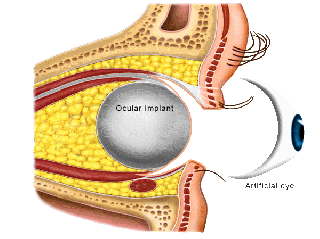
Removing the eye leaves a volume deficit of roughly 7 ml in the orbit. An orbital implant placed within the muscle cone restores that volume, supports the overlying prosthesis, and — when the extraocular muscles are attached — transmits movement to the prosthesis. The choice of material and design affects vascularization, motility, stability, and the long-term risk of migration or extrusion. Modern porous implants allow fibrovascular ingrowth, which anchors the implant in the patient’s own tissue.
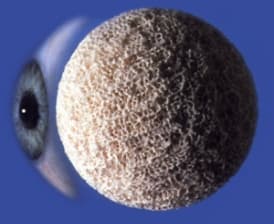
The original orbital implant is a smooth, solid sphere of silicone or acrylic (PMMA). It is inexpensive, well tolerated, and simple to place — often wrapped in donor sclera or an alternative wrap such as autologous fascia or synthetic mesh (donor tissue carries a very small theoretical risk of disease transmission) (or set within the patient’s own preserved scleral shell after evisceration) so the extraocular muscles can be attached to the wrap. Because the material is non-porous it does not vascularize and the muscles cannot integrate with it directly, so motility is transmitted indirectly and the historical rates of migration and extrusion are somewhat higher than with porous implants. It remains a reliable, low-cost choice in many sockets.
MEDPOR® is a lightweight, porous high-density polyethylene with an extensive interconnecting pore structure. Its porosity allows rapid fibrovascular ingrowth, integrating the implant into the patient’s tissues and often eliminating the need for separate wrapping grafts, although some surgeons still wrap the implant in selected cases. It is available in spheres (14–22 mm diameter) and custom shapes. The Conical Orbital Implant (COI)® variant includes suture tunnels for rectus-muscle attachment and a superior projection that reduces the post-operative superior-sulcus defect.
The coralline hydroxyapatite implant is a spherical implant composed of a naturally occurring calcium phosphate (hydroxyapatite) — the same mineral found in human bone. Its porous structure supports fibrovascular ingrowth and direct attachment of the extraocular muscles. Historically the most widely used porous implant, HA provides excellent motility and lower migration and extrusion rates than older non-porous synthetic materials. Like all porous implants, however, HA carries a small risk of anterior surface exposure, which occasionally requires a patch graft or revision surgery.
Bioceramic implants are made of porous alumina (Al2O3) with highly uniform interconnected pores (~500 µm). The extensive pore system enhances fibrovascular ingrowth and secure muscle attachment, which improves implant motility. The material is durable, less fragile than hydroxyapatite, and highly biocompatible.
A dermis-fat graft uses the patient’s own tissue — a disc of dermis with attached fat — as a living implant. Because it is autologous it integrates and can grow, which makes it especially valuable in children and in contracted or repeatedly failed sockets, where it restores both orbital volume and conjunctival surface area in a single step. Its main limitation is unpredictable fat resorption, so the final volume can vary.
Full guide: Dermis-Fat Graft — when it is used, technique, and outcomes →
A scleral shell is a thin, custom-made ocular prosthesis worn over a blind but cosmetically intact (or shrunken/phthisical) eye, or over a covered implant. It restores a natural appearance — matched and hand-painted by an ocularist to the fellow eye — without removing the globe. In evisceration, the patient’s own preserved sclera acts as a natural shell around the implant, contributing to the good motility often associated with that procedure.
Connect with a board-certified oculoplastic surgeon who specializes in ocular implants & scleral shell.
Search the Directory →