A guide to under-eye bags — distinguishing herniated fat, tear trough hollowing, festoons, and skin laxity, and matching each to the right treatment.
Medically reviewed by EyePlastics Medical Editorial BoardASOPRS oculoplastic surgeonsLast updated June 2026
“Under-eye bags” is one of the most common complaints we hear in oculoplastic practice — and one of the most misunderstood. Patients arrive convinced they need filler, or surgery, or a new eye cream, when in reality the term covers at least five distinct anatomic problems that look superficially similar but require completely different treatments. A puffy lower lid caused by herniated orbital fat will not improve with hyaluronic acid filler. A tear trough hollow will look worse after lower lid surgery if the fat is simply removed. Festoons — those hammocks of redundant skin and muscle that sit on the cheek — are notoriously resistant to every standard treatment and frequently made worse by filler.
This guide, written from the perspective of fellowship-trained ASOPRS oculoplastic surgeons, walks through how specialists actually evaluate the lower lid and cheek, why diagnosis must precede treatment, and which interventions are appropriate for which problem.
The puffy, shadowed, or tired appearance under the eyes is rarely one problem. In most patients it’s a combination of two or three of the following:
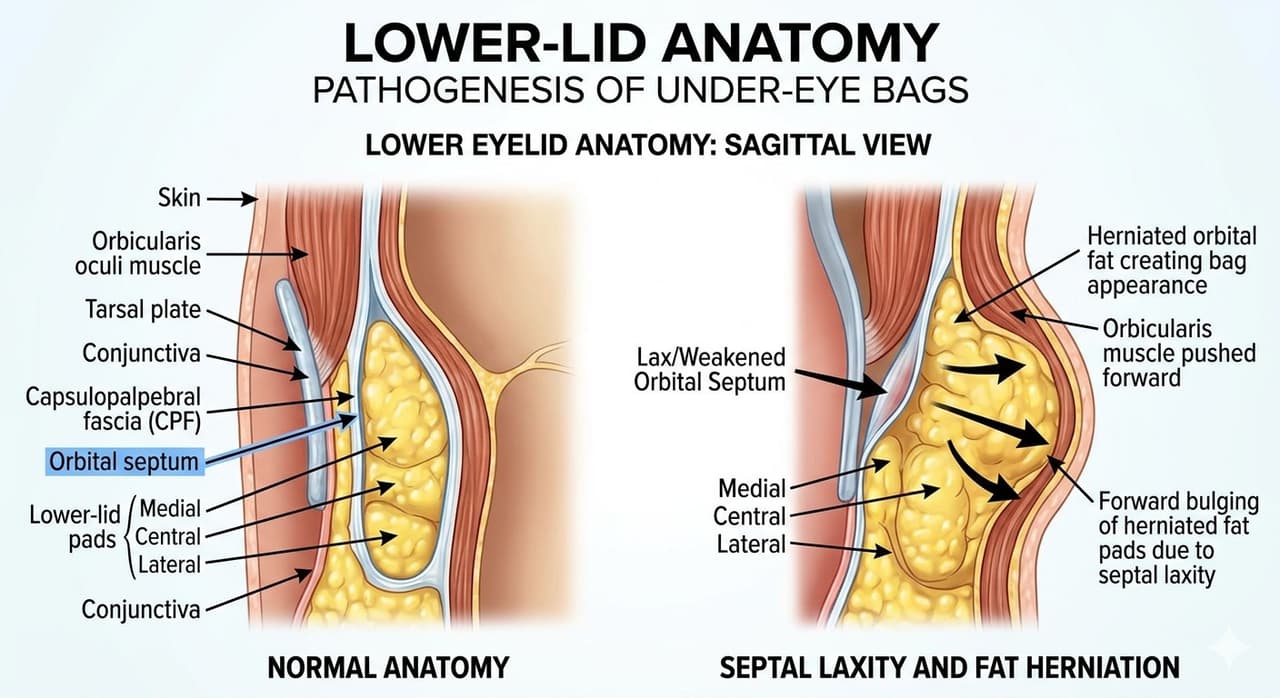
Behind the lower lid sit three fat compartments — medial, central, and lateral — that cushion the eye within the orbit. With age, the orbital septum (the connective tissue wall that holds this fat in place) weakens, and the fat pushes forward, creating visible convex pouches. This is the classic “bag” that worsens when you’re tired, after salt, or in the morning. It’s structural, progressive, and does not respond to creams, massage, or lymphatic drainage. Fat herniation is the problem that lower lid blepharoplasty was designed to treat.
The tear trough is the groove running from the inner corner of the eye diagonally down toward the cheek. It’s anchored by a true ligament (the tear trough ligament) that tethers skin to bone. As midface fat descends and the orbital rim becomes more visible with age, this groove deepens. The resulting shadow makes the area look dark and sunken — what patients often describe as “dark circles.” Importantly, tear trough hollowing can coexist with fat herniation: the fat bulges above the groove, the hollow sits below it, and together they create a dramatic shadowed contour.
Sun-damaged, thin lower lid skin develops fine wrinkling, hyperpigmentation, and a crepey texture independent of any underlying fat or volume problem. Patients with this finding often have smooth contours but persistent “tired eye” appearance from skin quality alone.
Festoons are hammock-like folds of lax skin and orbicularis muscle that sit on the cheek, below the orbital rim. Malar mounds are a related finding — persistent fluid-filled puffiness over the cheekbone. Both are distinct from orbital fat bags because they sit below the bony rim, not at the lid itself. Pressing on the bony rim does not flatten them. They are among the most difficult lower lid problems to treat and are commonly worsened by aggressive filler placement.
Morning puffiness that resolves over a few hours, puffiness associated with allergies, thyroid disease, kidney disease, or certain medications, is not surgical. Chronic allergic rhinitis with eye rubbing produces both pigmentation and edema. Thyroid dysfunction — particularly thyroid eye disease — can cause persistent lower lid fullness that mimics fat herniation but requires medical management first.
Important: Any patient with new-onset bilateral lower lid puffiness, lid retraction, or proptosis should be evaluated for thyroid eye disease before any cosmetic intervention. Treating it as a cosmetic problem can mask serious orbital pathology.
Here is the framework an oculoplastic surgeon uses at the slit lamp and in the mirror with the patient. The single most useful maneuver is having the patient look upward while you observe the lower lid: this accentuates fat herniation while flattening tear trough hollows.
| Finding on Exam | Likely Cause | Best-Matched Treatment |
|---|---|---|
| Convex bulge at lower lid, worse on upgaze, sits above orbital rim | Orbital fat herniation | Lower lid blepharoplasty (transconjunctival) |
| Diagonal groove from medial canthus to cheek, shadow without bulge | Tear trough hollowing | Filler, fat grafting, or tear trough release |
| Both a bulge and a hollow below it | Combined fat herniation & tear trough deformity | Blepharoplasty with fat repositioning |
| Crepey, wrinkled skin with smooth contour | Skin laxity / photoaging | Laser resurfacing, chemical peel, skin-only excision |
| Soft fold or puffiness below the rim, on the cheek | Festoon or malar mound | Direct excision, laser, or midface lift |
| Puffiness that fluctuates with sleep, salt, or season | Lymphatic / allergic | Medical management, not surgery |
| Bilateral fullness with lid retraction or eye prominence | Possible thyroid eye disease | Endocrine workup before any cosmetic plan |
The lower lid is unforgiving. Unlike the upper lid, where a moderately imperfect result is hidden by the brow and lid fold, every millimeter of the lower lid is visible in normal conversation. Mistakes here are not subtle. The most common bad outcomes we see in revision practice come from a single error: treating the wrong diagnosis.
An ASOPRS-trained oculoplastic surgeon completes a fellowship dedicated specifically to the eyelid, orbit, and periocular face. This is the exact area where a diagnostic miss becomes a permanent cosmetic problem.
For patients whose primary problem is herniated orbital fat, lower lid blepharoplasty is the definitive treatment. In most cases this is performed transconjunctivally — through the inside of the lower lid — leaving no visible external scar. The three fat compartments are accessed individually and either conservatively reduced or, more commonly today, repositioned over the orbital rim to fill the tear trough at the same time. This approach — fat-preserving rather than fat-removing — produces a smoother lid-cheek transition and avoids the hollowed look that older techniques caused.
For patients with hollowing but minimal fat bulge, hyaluronic acid filler placed deep, on bone, along the orbital rim can soften the shadow. This is a high-skill area: too superficial and the filler is visible or bluish, too much and the lower lid looks puffy or congested. Filler is a reasonable first step for younger patients with isolated tear trough deformity, but it is not a substitute for surgery when fat herniation is the dominant problem.
Autologous fat transfer harvests fat from the abdomen or thigh and grafts it along the orbital rim and midface. Unlike filler, the portion of grafted fat that survives tends to be long-lasting, though retention is variable and unpredictable, and it can address larger volume deficits across the whole midface. It’s often combined with blepharoplasty in patients who need both deflation of bags and restoration of midface volume.
When the underlying problem is descent of the cheek fat pad — effectively pulling the lower lid downward and exposing the orbital rim — a midface lift repositions the cheek tissue back over the rim. This is particularly useful in patients with negative vector anatomy (eye sits forward of the cheekbone) where standard blepharoplasty risks pulling the lower lid down.
For crepey, wrinkled, or pigmented skin without significant fat or volume issues, laser resurfacing (CO₂ or erbium), chemical peels, and medical-grade topicals can dramatically improve skin texture. Resurfacing is also a powerful adjunct after blepharoplasty to tighten residual skin that was not excised.
Festoons remain one of the most difficult periocular problems. Options include direct excision (effective but leaves a cheek scar), aggressive laser resurfacing, microneedling with radiofrequency, and in some cases, surgical tightening of the orbicularis muscle. There is no single perfect answer, and patients should be counseled that festoons rarely disappear completely.
A proper oculoplastic consultation for under-eye bags takes 30–45 minutes and includes a detailed history (allergies, thyroid status, sleep, prior treatments), an external exam with palpation of the orbital rim, evaluation of lid laxity (snap-back and distraction tests), assessment of midface position and vector, tear film and dry eye screening, and standardized photography. We frequently identify dry eye disease or pre-existing eyelid laxity that must be addressed before or during surgery to avoid postoperative complications.
Filler involves 3–7 days of mild swelling and possible bruising. Laser resurfacing requires a recovery period proportional to depth — from 3 days for light fractional treatments to 2 weeks of pinkness and crusting for deeper ablative resurfacing.
Lower lid surgery carries specific risks that distinguish it from other facial procedures: lid malposition (ectropion or retraction) if too much skin is removed or support is inadequate, chemosis (conjunctival swelling), dry eye exacerbation, asymmetry, and rare but serious bleeding into the orbit. Choosing a surgeon who operates routinely on the lower lid — not occasionally — is the single most important risk-reduction step.
Important: Be cautious of clinics that offer a single treatment (only filler, only laser, only surgery) for every under-eye complaint. A specialist’s job is to match the treatment to the diagnosis, not the other way around.
Yes. Hyaluronic acid fillers can be dissolved with hyaluronidase, an enzyme injected into the area. This is one of the most common procedures we perform in revision consultations — patients who had filler placed years ago and are now bothered by persistent lower lid puffiness or discoloration. Results are usually visible within days.
If the puffiness fluctuates dramatically with sleep, salt, or alcohol, then lifestyle changes will help. If the bags are present consistently regardless — the case for most adults over 40 — they represent structural fat herniation that lifestyle cannot reverse.
There’s no “right” age. We see patients in their late 20s with familial early fat herniation and patients in their 70s undergoing their first cosmetic procedure. The right time is when the appearance bothers you and the anatomic problem is amenable to surgery.
Lower lid blepharoplasty with fat repositioning is generally long-lasting, and for many patients it is a one-time procedure. The fat that’s removed does not come back, and the underlying anatomy is durable. Skin changes and midface descent continue with aging, but the “bag” itself is gone.
Overhead lighting accentuates any convex contour and deepens any shadow. Many patients first become aware of their bags through photography. This is not distortion — it’s the same anatomy others see in person under bright light.
It depends on the cause. Shadow-based dark circles (from tear trough hollowing) improve dramatically with filler or fat repositioning. True pigment-based dark circles (hyperpigmentation) require skin-directed treatment with topicals, peels, or laser. Vascular dark circles (visible underlying veins) are the hardest to treat. Diagnosis matters.
Occasionally, yes. Botulinum toxin placed too low can weaken the orbicularis muscle of the lower lid, which normally provides some compression of the underlying fat. This can unmask or accentuate pre-existing bags. Adjusting injection technique usually resolves the issue.
Under-eye bags are a diagnostic problem before they are a treatment problem. The single most important step you can take is being evaluated by a surgeon trained to distinguish the different anatomic causes — and to match the right treatment to your specific findings. Find an ASOPRS oculoplastic surgeon near you to begin with the right diagnosis.
Connect with a board-certified oculoplastic surgeon who specializes in under-eye bags.
Search the Directory →