A benign bone condition in which orbital bone is slowly replaced by fibrous tissue and expands — reshaping the orbit, pushing the eye forward, and occasionally threatening the optic nerve.
Medically reviewed by EyePlastics Medical Editorial Board·ASOPRS oculoplastic surgeons·Last updated June 2026
What Is Fibrous Dysplasia of the Orbit
Fibrous dysplasia is a benign, slowly progressive bone condition in which normal bone is replaced by fibrous tissue and immature, poorly formed woven bone. When it involves the bones around the eye, the affected bone gradually expands and thickens, reshaping the orbit and the surrounding face. It most often appears in childhood or adolescence and tends to stabilize after skeletal maturity, although it can remain active into adulthood.
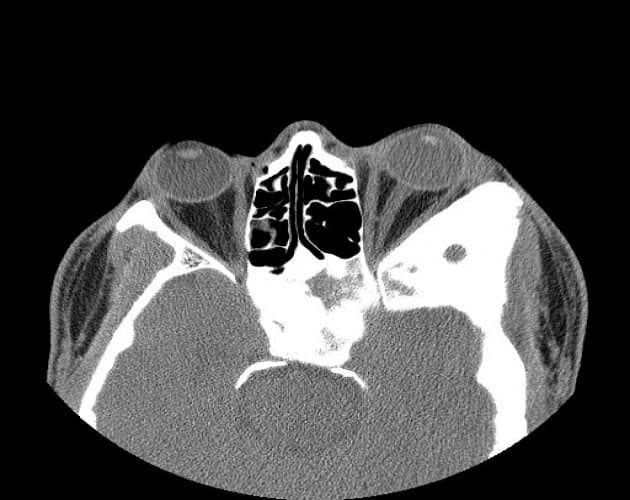
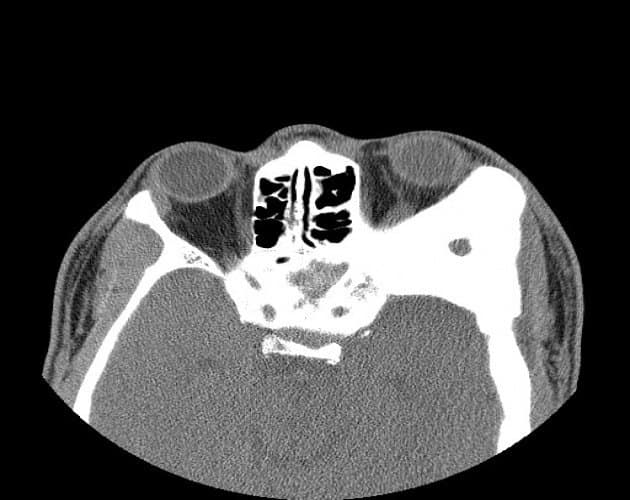
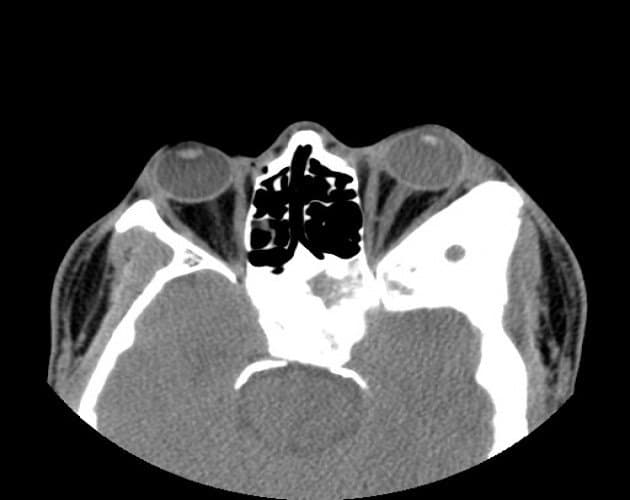
CT scan — fibrous dysplasia expanding the orbital bone, with the characteristic hazy “ground-glass” matrix
Monostotic vs. polyostotic. Fibrous dysplasia may affect a single bone (monostotic — the most common form) or several bones (polyostotic). The polyostotic form can be part of McCune–Albright syndrome, which also includes café-au-lait skin patches and hormonal (endocrine) overactivity such as precocious puberty.
How It Presents
Because the bone enlarges very slowly, the changes are usually painless and develop over years. Orbital involvement produces signs that reflect the expanding bone crowding the orbit and its structures:
Progressive facial asymmetry or a firm bony swelling around the eye
Proptosis (forward protrusion of the eye) and downward or sideways displacement of the globe (dystopia)
Narrowing of the bony optic canal, which can compress the optic nerve and threaten vision
Double vision (diplopia) if eye movement is restricted
Tearing if the tear-drainage channel through the bone is narrowed
Expanded, ground-glass orbital bone on CTBony reshaping and thickening of the orbital walls
Imaging & Diagnosis
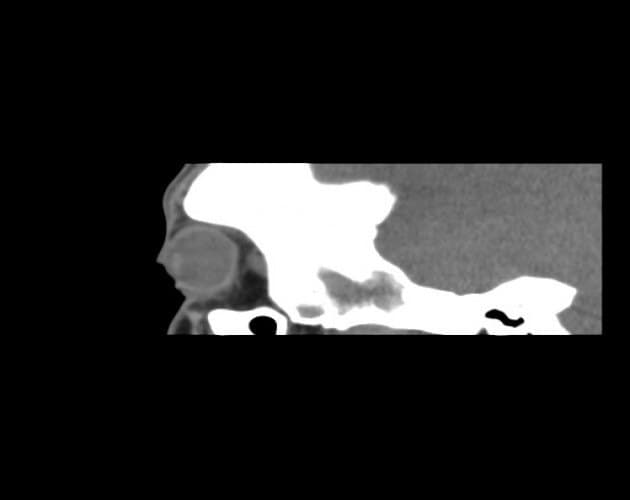
CT scanning is the key investigation. Fibrous dysplasia has a characteristic hazy, “ground-glass” appearance where the normal bone has been replaced, together with expansion and thickening of the affected bone. This appearance, combined with the clinical picture, usually makes the diagnosis without the need for biopsy.
CT — ground-glass expansion of orbital bone characteristic of fibrous dysplasia
Treatment
Management is guided by symptoms and by whether the disease is active or stable.
Observation with periodic imaging is appropriate for stable, asymptomatic disease
Surgical contouring or removal of the abnormal bone is used to correct disfigurement, restore the position of the eye, or relieve pressure on orbital structures
Optic-nerve (optic-canal) decompression is reserved for documented, progressive vision loss from optic-nerve compression; routine “preventive” decompression of a normal-vision eye is generally avoided because of surgical risk
Bisphosphonate medication can help bone pain in active disease
Radiation therapy is contraindicated. Irradiating fibrous dysplasia does not help and significantly increases the small risk of malignant transformation. Spontaneous malignant change is otherwise rare (well under 1%).
Fibrous dysplasia is one of several conditions that enlarge the orbit and push the eye forward. For the broader work-up of orbital masses see Orbital Tumors; for surgical reduction of orbital volume see Orbital Decompression.
Frequently Asked Questions
What is fibrous dysplasia of the orbit?
Fibrous dysplasia is a benign bone condition in which normal bone is replaced by fibrous tissue and weak, immature bone. Around the eye, the affected bone slowly expands and thickens, reshaping the orbit and the face. It usually appears in childhood or adolescence and often stabilizes after growth is complete.
Can fibrous dysplasia of the orbit affect vision?
It can. As the bone expands it may narrow the bony canal that the optic nerve passes through, compressing the nerve and threatening vision. It can also push the eye forward (proptosis) and cause double vision. Regular monitoring is important in orbital cases.
Does fibrous dysplasia of the orbit need surgery?
Not always. Stable, symptom-free disease is monitored with periodic imaging. Surgery — contouring or removing the abnormal bone — is used for disfigurement, to reposition the eye, or to relieve pressure on the optic nerve. Importantly, radiation therapy is avoided because it increases the small risk of malignant change.
Find a Specialist
Connect with a board-certified oculoplastic surgeon who specializes in fibrous dysplasia of the orbit.