- Home
- Services
- Orbital Tumors
- Cavernous Hemangioma (Cavernous Venous Malformation)
Cavernous Hemangioma (Cavernous Venous Malformation)
The most common benign orbital tumor of adults β a slow-growing, well-encapsulated vascular lesion that presents with gradual painless proptosis and is curable with surgical excision.
The Most Common Benign Orbital Tumor of Adults
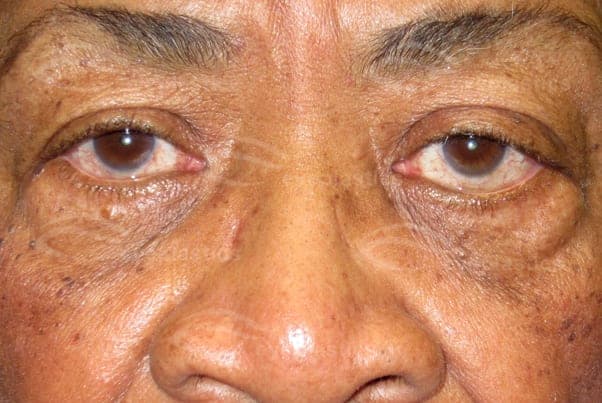
A cavernous hemangioma — formally a cavernous venous malformation — is a benign, slow-growing vascular lesion composed of large, blood-filled channels within a well-defined fibrous capsule. It is the most common benign orbital tumor in adults, typically diagnosed between ages 20 and 60 and more often in women. Most arise within the muscle cone directly behind the eye, which is why their hallmark is a slow, painless, forward displacement of the globe.
Symptoms & Signs
- Gradual painless proptosis — the eye is slowly pushed forward over months to years; old photographs often reveal how long the change has been developing
- Hyperopic shift / blurred vision — pressure on the back of the eye shortens its focusing length and can cause retinal striae (choroidal folds)
- Double vision — from mass effect on the extraocular muscles in larger lesions
- Optic nerve compression — lesions at the orbital apex may affect vision or color vision even when small — the main reason apex lesions are managed differently
- Many are asymptomatic — found incidentally on a CT or MRI obtained for another reason
Imaging & Diagnosis
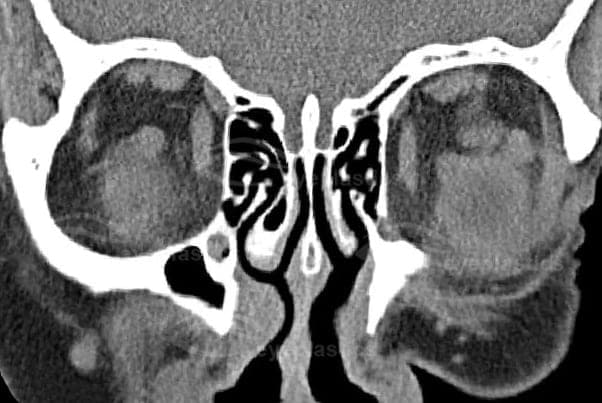
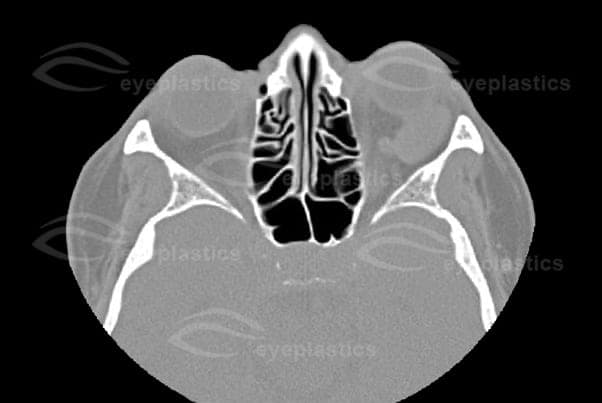
The diagnosis is usually made confidently on imaging without a biopsy. CT shows a well-circumscribed, round or oval intraconal mass. MRI is characteristic: the lesion is isointense to muscle on T1, brightly hyperintense on T2, and shows progressive “filling-in” enhancement on dynamic contrast sequences — contrast puddles slowly through the cavernous channels, a pattern that distinguishes it from other orbital tumors such as schwannoma or lymphangioma.
Treatment
- Observation — appropriate for small, asymptomatic, incidentally-found lesions: periodic eye exams, visual fields, and surveillance imaging
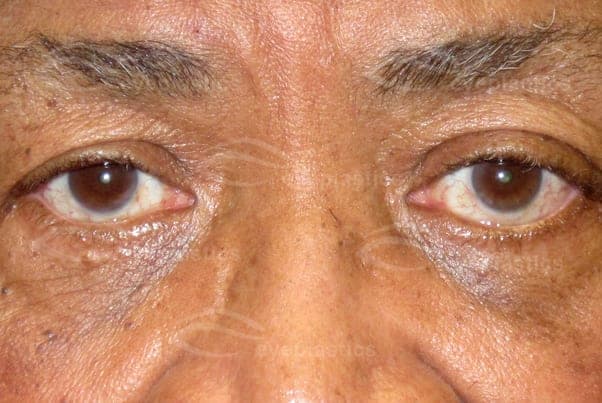
- Surgical excision — indicated for progressive proptosis, visual change, diplopia, or optic-nerve compression. Because the tumor is encapsulated and does not infiltrate, it can usually be dissected free and removed intact through an orbitotomy — lateral, anterior, or transconjunctival depending on its position — and complete excision is curative
- Apex lesions — lesions wedged at the orbital apex carry higher surgical risk to the optic nerve; management is individualized and may favor observation or staged approaches
Capillary vs. Cavernous — Same Word, Different Diseases
| Capillary (infantile) hemangioma | Cavernous hemangioma | |
|---|---|---|
| Who | Infants — appears in the first weeks of life | Adults — usually ages 20–60, women more often |
| Behavior | Grows rapidly, then shrinks away on its own (most gone by age 9) | Grows slowly and persists — never involutes |
| Location | Eyelid and front of the orbit, often a visible red lesion | Deep in the orbit behind the eye — usually nothing visible externally |
| Main risk | Amblyopia in the developing visual system | Proptosis and optic-nerve compression |
| Treatment | Observation; propranolol if vision threatened | Observation; surgical excision if symptomatic (curative) |
See the companion page: Capillary Hemangioma (infantile).
Frequently Asked Questions
- Is a cavernous hemangioma cancer?
- No. A cavernous hemangioma (now formally called a cavernous venous malformation) is a benign, well-encapsulated vascular lesion. It does not invade tissue or spread; its only effects come from slowly occupying space within the orbit and pressing on the eye or optic nerve.
- Does every cavernous hemangioma need surgery?
- No. Small, asymptomatic lesions found incidentally on a scan are often simply observed with periodic imaging and vision checks. Surgery β usually complete excision through an orbitotomy β is recommended when the lesion causes progressive proptosis, double vision, pressure on the optic nerve, or visual change. Because the tumor is encapsulated, complete removal is usually curative.
- How is it different from the hemangioma my child had?
- Despite sharing a name, they are different conditions. The capillary (infantile) hemangioma is a proliferating tumor of infancy that usually shrinks away on its own. The cavernous hemangioma is an adult lesion β typically diagnosed between ages 20 and 60, more often in women β that grows slowly and never involutes. One fades; the other persists until removed (if removal is needed).
Find a Specialist
Connect with a board-certified oculoplastic surgeon who specializes in cavernous hemangioma (cavernous venous malformation).
Search the Directory βRelated Conditions
Orbital Tumors
Diagnosis and surgical management of orbital tumors and masses β adult and pediatric, benign and malignant.
Learn more βCapillary Hemangioma
The most common orbital and eyelid tumor of childhood β a benign 'strawberry' vascular birthmark that usually fades on its own but can threaten vision when it blocks or presses on the eye.
Learn more βAnophthalmos
Surgical and prosthetic management of anophthalmos (absence of the eye) and socket reconstruction following enucleation or evisceration.
Learn more β