A decision guide for hooded upper eyelids: is the problem excess eyelid skin, descended brows, or both — and what is the right surgical answer?
Medically reviewed by EyePlastics Medical Editorial BoardASOPRS oculoplastic surgeonsLast updated June 2026
“My eyes look tired and heavy — can you fix them?” It is one of the most common requests an oculoplastic surgeon hears, and it is also one of the most commonly misdiagnosed. The patient assumes the problem is the eyelid. Sometimes it is. But just as often, the heaviness above the eye comes from a brow that has slowly descended over decades, pushing forehead skin down onto the eyelid platform. The difference matters enormously: operating on the wrong structure produces a result that is technically clean but aesthetically wrong — and sometimes worse than doing nothing at all.
This guide explains how oculoplastic surgeons distinguish brow descent from true upper eyelid excess, when each procedure is appropriate, when both are needed, and why the order in which they are performed is not negotiable.
The upper eyelid and the eyebrow are anatomically continuous. Skin flows uninterrupted from the hairline, across the forehead, over the brow ridge, and down to the eyelash margin. When a patient pinches the heavy fold above their eye and says “this is too much skin,” they are correct that there is excess tissue — but the question is where that tissue originates.
There are two fundamentally different sources of upper eyelid hooding:
The two conditions look similar from across the room. They are not similar at all on examination, and they require opposite operations.
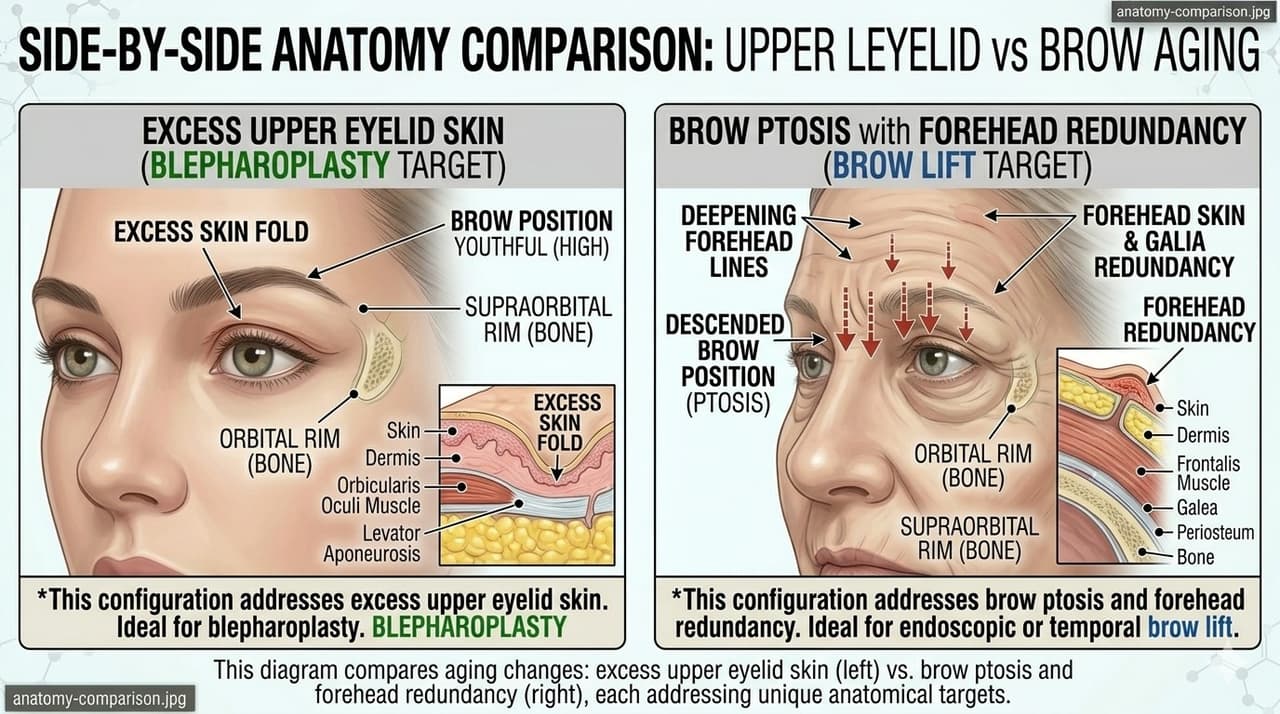
The single most useful concept for patients: blepharoplasty removes eyelid skin; brow lift relocates the brow. They are not interchangeable, and one cannot substitute for the other. Learn more at Blepharoplasty and Brow Lift.
Distinguishing the two problems takes about thirty seconds in the consultation room, but the assessment must be done deliberately. The patient is asked to look straight ahead, with the forehead relaxed — not raised. Most patients with brow ptosis unconsciously activate the frontalis muscle to lift the brow off the eye, and if this compensation is not neutralized, the brow position on examination will look falsely normal.
The aesthetic targets are not arbitrary; they are based on facial proportions that read as youthful and rested:
The examiner places a thumb on the brow and gently elevates it to its ideal anatomic position while the patient looks straight ahead. Several things are observed:
Important: Never evaluate brow position with the patient’s forehead actively contracting. Ask them to close their eyes, relax fully, then open without raising the brow. This unmasks true resting brow position, which can be a full centimeter lower than the position they have been holding all day.
Upper blepharoplasty by itself is the right operation when:
This is the classic patient in their late forties through sixties with good bony architecture, a brow that has aged gracefully, and an eyelid that has not. They can be improved beautifully with a conservative skin excision — sometimes with a small strip of orbicularis muscle and a touch of medial fat — and the brow is left entirely alone.
In thinner-skinned patients and in younger patients, the operation can be remarkably restorative with very little tissue removed. Aggressive blepharoplasty in a patient who actually needs a brow lift is one of the classic errors discussed below.
A brow lift by itself — with no eyelid surgery at all — is appropriate when:
The technique chosen — endoscopic, temporal, direct, or pretrichial — depends on hairline position, forehead height, brow shape, and gender. What matters from a decision-making standpoint is that the operation targets the right structure. A patient with a beautifully shaped, properly elevated brow and minimal forehead lines almost never needs a brow lift; a patient with a brow sitting on the lash line almost never benefits from blepharoplasty alone.
Many patients — perhaps the majority over age sixty — have both brow descent and true upper eyelid skin excess. The brow has dropped, and independently the eyelid skin has stretched. In these patients, doing only one operation leaves the other problem visible, and the result looks incomplete.
When both procedures are performed, the brow lift is done first — or at minimum simultaneously, with the brow set before the eyelid skin is marked. The reason is mechanical:
Important: Never allow blepharoplasty skin to be marked and excised before brow position is finalized. Doing the eyelid first “because it’s easier” and adding a brow lift later is the most common path to permanent lagophthalmos.
When done in the correct order — brow set first, then conservative eyelid skin excision based on the new brow position — the combined operation produces a result that neither procedure alone could achieve: a properly elevated, naturally shaped brow over a clean, age-appropriate eyelid platform.
Choosing the wrong operation produces predictable, recognizable, and largely preventable problems.
This is the most common error in cosmetic eyelid surgery. The brow ptosis is missed or ignored, and eyelid skin is removed instead. Several things happen:
Less common but equally unflattering: the brow is elevated, but the eyelid skin still drapes heavily over the lash line. The patient now has surprised, high brows and heavy lids — the worst of both worlds. The lateral tail can also be over-elevated, producing a perpetually quizzical look that ages poorly.
Eyelid skin excised before the brow is set leads to lagophthalmos — sometimes mild and treatable with lubrication, sometimes severe and requiring skin grafting. This is preventable simply by sequencing the operations correctly.
There is a third source of “heavy, tired-looking eyes” that mimics both brow descent and dermatochalasis: true eyelid ptosis, in which the upper eyelid margin itself sits too low because the levator muscle has weakened or detached.
Ptosis is structurally different from the other two problems:
The clue is measurement: the distance from the corneal light reflex to the upper eyelid margin (MRD1) is normally about 4–5 mm. In ptosis it is reduced, often to 2 mm or less. Patients compensate by raising the brow, which makes the brow look high — another reason to evaluate brow position with the forehead truly relaxed.
Missing ptosis and operating only on brow or skin produces a patient whose “tired look” persists after a beautifully executed procedure, because the actual problem was never addressed. All three variables must be evaluated together. A complete plan often involves repairing the levator muscle in addition to, or instead of, treating skin and brow.
Ptosis repair is its own operation with its own anatomy and its own risks. Read more at Ptosis, and see also Upper Facial Aging for the integrated view.
| Feature | Upper Blepharoplasty | Brow Lift |
|---|---|---|
| Target tissue | Excess upper eyelid skin (± fat, muscle) | Descended eyebrow and forehead |
| Incision | Hidden in upper lid crease | Endoscopic scalp ports, temporal, hairline, or direct |
| Effect on brow position | None — or slight further descent | Elevates brow to ideal position |
| Effect on eyelid platform | Restores visible platform directly | Restores platform by lifting tissue off the lid |
| Effect on forehead lines | None | Softens horizontal lines and frown lines |
| Typical recovery | 7–10 days of bruising | 10–14 days, scalp numbness for weeks |
| Key risk if wrong choice | Brow drops further; hooding returns | Surprised look; residual lid heaviness |
A good oculoplastic consultation for upper face heaviness should always address all three variables — brow, eyelid skin, and lid margin position — and the surgeon should be able to explain, in front of a mirror, which structure is contributing what. If the recommendation is “just a blepharoplasty” without any discussion of brow position, ask why. If the recommendation is “just a brow lift” without examining the eyelid platform, ask why. The right answer for any individual patient may be one procedure, both procedures, or a different operation altogether — but it should be a reasoned answer based on a structured examination, not a default.
If you are considering surgery for hooded, heavy, or tired-looking upper eyelids, the most valuable step you can take is a consultation with an ASOPRS fellowship-trained oculoplastic surgeon — the specialists who routinely manage all three structures and who can tell you, with confidence, which operation will actually solve your problem. Find a fellowship-trained oculoplastic surgeon near you to begin.
Connect with a board-certified oculoplastic surgeon who specializes in brow lift vs upper blepharoplasty.
Search the Directory →