Soft yellow cholesterol-rich plaques on the eyelids (xanthelasma palpebrarum) — evaluation of any associated lipid disorder and removal by excision, laser, or chemical treatment.
Medically reviewed by EyePlastics Medical Editorial BoardASOPRS oculoplastic surgeonsLast updated June 2026
Xanthelasma — more precisely xanthelasma palpebrarum — are soft, yellow, flat or slightly raised plaques made of cholesterol-laden cells that build up in the thin skin of the eyelids. They most often appear near the inner corner of the upper lid and may be symmetric on both sides. Xanthelasma are benign: they are not a tumor, are not contagious, and do not turn into cancer. For many people the concern is cosmetic, but the plaques can also be an outward clue to cholesterol metabolism and cardiovascular risk.
This is an in-depth companion to our main Eyelid Skin Tumors & Lesions guide. Xanthelasma is the most common of the eyelid xanthomas and is frequently removed alongside blepharoplasty.
Xanthelasma form when lipid-rich macrophages (“foam cells”) accumulate in the dermis of the eyelid skin. About half of affected people have a measurable lipid abnormality — elevated LDL cholesterol, low HDL, or an inherited dyslipidemia — while the other half have normal blood lipids. Independent of cholesterol numbers, studies link xanthelasma to a higher long-term risk of heart disease, so the plaques are worth taking seriously as a health signal. A fasting lipid panel and a conversation with your primary-care physician are sensible first steps.
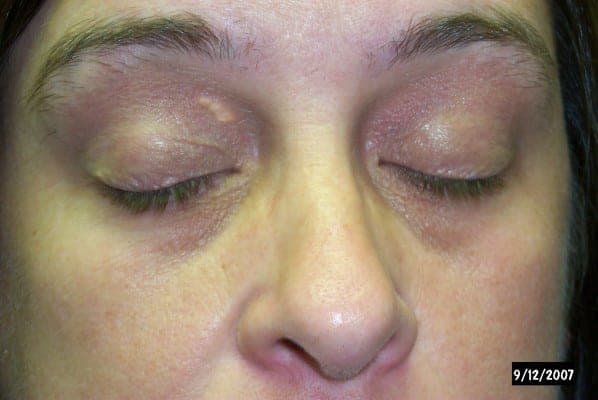
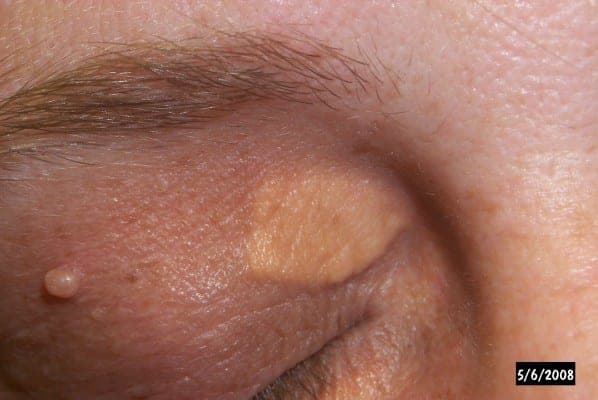
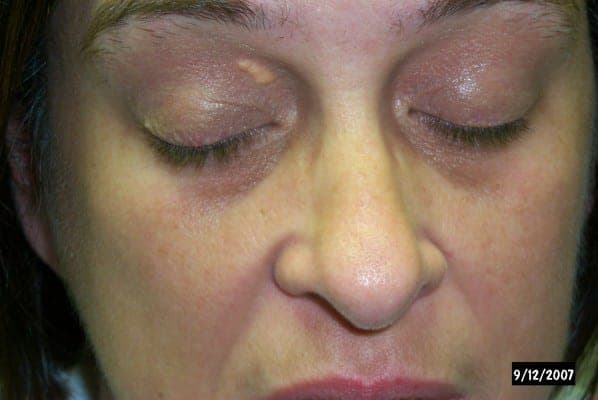
Typical features are creamy-yellow, well-defined, soft plaques that feel slightly velvety and sit just under the skin surface. They grow slowly over months to years, are painless, and do not ulcerate or bleed — features that help distinguish them from a true eyelid tumor. When a yellowish lesion is firm, irregular, ulcerated, or rapidly changing, it should be evaluated to exclude a " + "skin cancer".
Xanthelasma is usually a clinical diagnosis — an oculoplastic surgeon can recognize the characteristic yellow plaques on examination. Because look-alikes exist (including sebaceous lesions and, rarely, sebaceous carcinoma), any atypical lesion may be biopsied. Beyond the eyelid, evaluation includes a fasting lipid profile and, when indicated, screening for diabetes and thyroid or liver conditions that affect lipids.
Xanthelasma do not require removal for health reasons, but many patients choose treatment for appearance. Options include:
Because eyelid skin is delicate and close to the eye, technique selection and meticulous handling matter; over-aggressive treatment can cause scarring, pigment change, or eyelid malposition.
Xanthelasma recur in roughly a quarter to 40% of cases, and the risk is higher after repeat treatment. Recurrence is more likely when lesions are large, when all four eyelids are involved, and when an underlying lipid disorder is left untreated. Controlling cholesterol and selecting the appropriate removal method for the lesion thickness both lower the chance of return.
Consider specialist evaluation if the plaques are enlarging, cosmetically bothersome, or if a lesion looks atypical (firm, ulcerated, or rapidly changing). An oculoplastic surgeon can confirm the diagnosis, coordinate a lipid work-up, and remove the plaques with attention to eyelid function and appearance.
See an oculoplastic surgeon
Eyelid lesions sit millimeters from the eye, where removal and reconstruction demand specialist care. Find an ASOPRS-trained oculoplastic surgeon near you.
Connect with a board-certified oculoplastic surgeon who specializes in xanthelasma.
Search the Directory →