EyePlastics
Find a Doctor

Demodex Blepharitis

Eyelash-mite infestation (Demodex folliculorum & brevis) — the cause of collarettes, chronic lid irritation, and a common driver of blepharitis, MGD, and dry eye.

Medically reviewed by EyePlastics Medical Editorial BoardASOPRS oculoplastic surgeonsLast updated June 2026

What is Demodex Blepharitis

Demodex blepharitis is a chronic inflammation of the eyelid margins caused by an overpopulation of microscopic Demodex mites that live in and around the eyelash follicles and the oil (meibomian) glands of the lids. It is one of the most common — and most frequently missed — causes of blepharitis. Mites are a normal resident of human skin, but when their numbers rise they trigger lid-margin irritation, the characteristic waxy debris called collarettes, and a cycle of itching, redness, and tear-film instability.

This page is the in-depth companion to our main Blepharitis guide. Demodex overlaps heavily with meibomian gland dysfunction (MGD), dry eye disease, and ocular rosacea — the conditions are often treated together.

The Two Mites Behind the Disease

Two related species cause ocular Demodex disease, and they tend to produce two different patterns of blepharitis:

Demodex folliculorum

Lives inside the eyelash follicle, usually in clusters around the lash root.

  • Drives anterior blepharitis
  • Produces the cylindrical collarettes wrapped around the lash base
  • Associated with lash misdirection, lash loss, and recurrent irritation

Demodex brevis

Burrows deeper into the meibomian and sebaceous glands.

  • Contributes to posterior blepharitis and MGD
  • Plugs gland orifices, worsening evaporative dry eye
  • Linked to recurrent chalazia

Because the two species occupy different parts of the lid, many patients have a mixed picture — anterior collarettes and meibomian gland obstruction — which is why Demodex is so often intertwined with dry eye and MGD.
Collarettes — The Telltale Sign

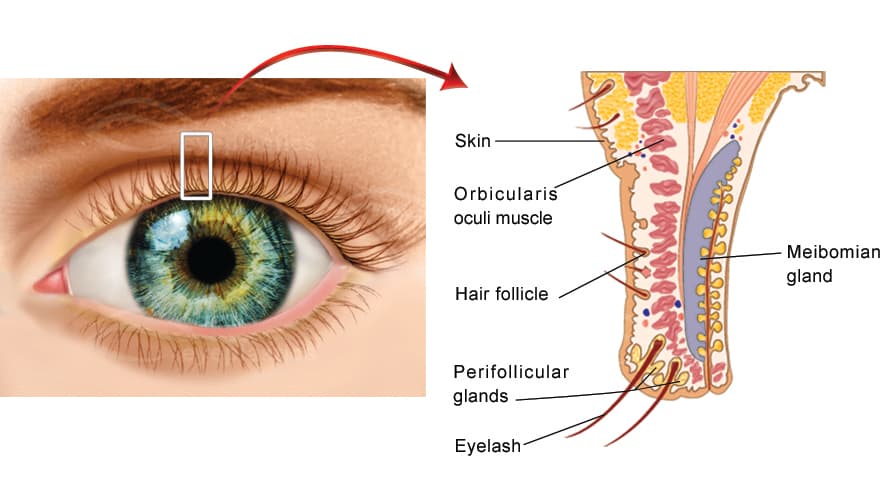
Eyelash follicle and meibomian gland anatomy where Demodex mites live
Demodex mites colonize the lash follicles (anterior lid) and meibomian glands (posterior lid).

Collarettes — sometimes called cylindrical dandruff — are translucent, waxy cuffs of mite waste and skin debris that form a clear sleeve around the base of the eyelashes. They are considered pathognomonic for Demodex: if a patient has collarettes, they have Demodex blepharitis. Unlike the hard, brittle scales (scurf) of staphylococcal blepharitis, collarettes are soft, semi-clear, and slide up the lash as it grows.

Clinical pearl: Collarettes are best seen by asking the patient to look down while examining the upper lid lashes at the slit lamp. Their presence and number are now used to grade disease severity and to track response to treatment.

Who Gets It

Demodex colonization rises steadily with age — it is nearly universal in the elderly — but symptomatic disease can occur at any age. Recognized associations include:

  • Older age — the single strongest risk factor
  • Facial and ocular rosacea — strongly linked to Demodex overgrowth
  • Chronic blepharitis, MGD, and dry eye that has not responded to standard lid hygiene
  • Recurrent chalazia or styes
  • Oily skin (seborrhea), diabetes, and immune compromise
  • Long-term contact lens wear and incomplete eye-makeup removal

Symptoms

  • Itching of the eyelid margins — often the dominant complaint, classically worse in the morning
  • Burning, foreign-body or gritty sensation
  • Red, irritated, crusted lid margins with debris at the lash bases
  • Watery eyes alternating with dryness and fluctuating, blink-dependent blurred vision
  • Lashes that feel sticky, brittle, misdirected, or that fall out (madarosis)
  • Recurrent chalazia and a feeling that "nothing the patient tries fully works"

Diagnosis

Demodex blepharitis is diagnosed at the slit lamp — no blood test or culture is required:

  • Collarette identification: Finding cylindrical collarettes at the lash bases confirms the diagnosis. The number of lashes with collarettes is used to grade severity.
  • Lash rotation / epilation microscopy: Rotating or epilating a lash and viewing it under the microscope reveals the mites directly — the historic confirmatory test.
  • Lid-margin and meibomian assessment: Evaluating for plugged meibomian orifices, telangiectasias, and reduced tear break-up time identifies coexisting MGD and dry eye.

Treatment

The goals of treatment are to reduce the mite population, clear collarettes, calm inflammation, and manage the dry eye and MGD that usually accompany it. Because mites repopulate, Demodex blepharitis is managed as a chronic, relapsing condition rather than a one-time cure.

Prescription therapy — lotilaner (XDEMVY™)

XDEMVY (lotilaner ophthalmic solution 0.25%) is the first and only FDA-approved prescription treatment specifically for Demodex blepharitis. Lotilaner paralyzes and kills the mites by targeting their nervous system. It is dosed as one drop in each eye twice daily for six weeks. In the phase 3 Saturn-1 and Saturn-2 trials, a significantly greater proportion of treated patients achieved collarette cure (reduction to no more than two collarettes) and mite eradication compared with vehicle — roughly half of treated patients reached collarette cure — with the most common side effect being mild, transient stinging or burning at instillation.

Lid hygiene & tea tree oil

  • Terpinen-4-ol (tea tree oil derivative): The active ingredient in tea tree oil with anti-Demodex activity. Available as pre-moistened lid wipes (e.g., Cliradex) for daily home use. Concentrated tea tree oil is irritating and should not be applied undiluted near the eye.
  • Hypochlorous acid spray and commercial lid cleansers reduce the bacterial and biofilm load that accompanies mite overgrowth and support the prescription regimen.
  • Warm compresses and lid massage address the coexisting meibomian gland obstruction.

In-office procedures

  • Microblepharoexfoliation (BlephEx): Mechanical debridement of the lid margin with a rotating micro-sponge to remove collarettes, biofilm, and debris.
  • Intense Pulsed Light (IPL): Periocular pulsed light reduces Demodex populations and rosacea-associated telangiectasias while improving meibomian gland function; typically a series of 3–4 sessions.
  • Meibomian gland expression / thermal pulsation (LipiFlow): Clears the gland obstruction driven by Demodex brevis.

Treat the whole lid. Because Demodex, MGD, dry eye, and rosacea reinforce one another, the most durable results come from combining mite-directed therapy with ongoing meibomian gland and ocular-surface care.

When to See a Specialist

See an eye physician or oculoplastic specialist if you have persistent eyelid itching, redness, or crusting that does not improve with over-the-counter lid hygiene, recurrent styes or chalazia, or chronic dry-eye symptoms that have not responded to drops. A simple slit-lamp examination for collarettes can confirm Demodex blepharitis and open the door to targeted, effective treatment.

Frequently Asked Questions

What is Demodex blepharitis?
Demodex blepharitis is chronic eyelid-margin inflammation caused by an overpopulation of microscopic Demodex mites living in the eyelash follicles and oil glands. It produces itching, redness, crusting, and characteristic waxy collarettes at the lash bases.
What are collarettes?
Collarettes are translucent, waxy cuffs of mite waste and debris that wrap around the base of the eyelashes. They are the hallmark sign of Demodex blepharitis — their presence essentially confirms the diagnosis.
Is Demodex blepharitis contagious?
Demodex mites are normal residents of human skin and are not considered contagious in the usual sense. Disease results from an overgrowth of the mites, not from catching them from someone else.
How is Demodex blepharitis treated?
Treatment combines mite-directed therapy — prescription lotilaner ophthalmic solution (XDEMVY) or tea-tree-oil (terpinen-4-ol) lid wipes — with lid hygiene and management of coexisting meibomian gland dysfunction and dry eye. In-office options include microblepharoexfoliation (BlephEx) and intense pulsed light (IPL).
Can Demodex blepharitis be cured permanently?
Because mites naturally repopulate the skin, Demodex blepharitis is managed as a chronic, relapsing condition. Treatment can clear collarettes and dramatically reduce symptoms, but ongoing lid hygiene helps prevent recurrence.
Who is most at risk for Demodex blepharitis?
Risk rises sharply with age and is strongly associated with facial and ocular rosacea, chronic blepharitis or dry eye that hasn't responded to standard care, recurrent chalazia, oily skin, and incomplete eye-makeup removal.
How is Demodex blepharitis different from regular blepharitis?
Demodex blepharitis is a specific cause of blepharitis driven by eyelash mites, identified by collarettes at the lash base. Other forms are caused by bacteria (staphylococcal), oil-gland dysfunction (MGD/posterior), or seborrhea, and are treated differently.

Find a Specialist

Connect with a board-certified oculoplastic surgeon who specializes in demodex blepharitis.

Search the Directory →