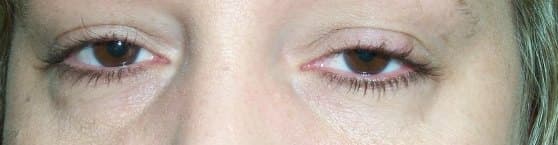
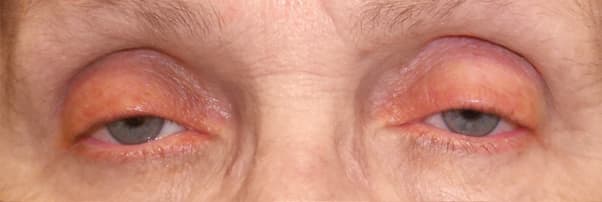
Acquired Ptosis
Drooping eyelids that develop later in life β most often aponeurotic (age-related), but also from nerve problems, trauma, or eye surgery.
Acquired Ptosis
Most adult ptosis is aponeurotic — the levator muscle is intact and still strong, but the fibrous aponeurosis (tendon) that transmits the muscle’s pull to the tarsus has stretched, thinned, or detached. The lid sits low not because of muscle weakness but because the mechanical connection is lost.
Common Causes
- Aging: the most common cause by far — the aponeurosis disinserts from the tarsus gradually over decades. Levator function typically remains excellent (≥ 10 mm)
- Long-term contact lens wear: repeated mechanical trauma from lens insertion and removal stretches the aponeurosis; a common cause in younger adults
- Prior intraocular surgery: lid speculum use during cataract surgery is a well-recognized precipitant
- Chronic eye rubbing or inflammation: repeated lid traction weakens the aponeurosis over time
- Myasthenia gravis: a neuromuscular disorder producing variable, fatigable ptosis that characteristically worsens as the day progresses — must be excluded before planning surgery
- Third nerve (CN III) palsy: causes complete ptosis with a dilated, unreactive pupil; the pupil-involving form is a neurological emergency requiring urgent imaging

Treatment of Acquired Ptosis
Because the levator muscle itself is usually strong in aponeurotic ptosis, repair simply re-attaches or tightens its stretched tendon. The approach is guided by the phenylephrine response:
- External — levator advancement: through a hidden upper-lid-crease incision, the levator aponeurosis is re-secured to the tarsus. The most common and versatile repair, and the one that allows excess skin to be removed at the same time. Learn more →
- Internal — Müller’s muscle–conjunctival resection (MMCR): done from the back of the lid with no skin incision; ideal for mild ptosis with a positive phenylephrine test. Learn more →
- Upneeq® drops: a once-daily, non-surgical 1–2 mm lift for mild cases or patients avoiding surgery. Learn more →
Important: new-onset unilateral ptosis with a dilated, unreactive pupil requires same-day neurological evaluation to exclude cerebral aneurysm or transtentorial herniation.
Frequently Asked Questions
- What is the most common cause of a droopy eyelid in adults?
- Aponeurotic (involutional) ptosis β the levator muscle's tendon stretches or detaches with age, contact-lens wear, or after eye surgery, letting the lid drift down while the muscle still works.
- Can acquired ptosis come on suddenly?
- A sudden droop β especially with double vision, a large or small pupil, or pain β needs urgent evaluation, as it can signal a nerve (third-nerve palsy), Horner's syndrome, or myasthenia gravis.
Find a Specialist
Connect with a board-certified oculoplastic surgeon who specializes in acquired ptosis.
Search the Directory βRelated Conditions
Ptosis Evaluation & Diagnosis
How a droopy eyelid is evaluated β margin reflex distance, levator function, the phenylephrine (Neo-Synephrine) test, Hering's law, and visual-field impact.
Learn more βPtosis Treatment & Surgery
Surgical and non-surgical ptosis treatment β MΓΌller's-muscle resection (Putterman), levator advancement, frontalis sling, Fasanella-Servat, and Upneeq eye drops.
Learn more βPtosis
Repair of drooping upper eyelids (ptosis) β both cosmetic and functional correction of levator muscle weakness.
Learn more β