Hyaluronic acid and biostimulatory dermal fillers for periorbital and facial volume restoration — tear trough, cheeks, lips, and nasolabial folds.
Medically reviewed by EyePlastics Medical Editorial BoardASOPRS oculoplastic surgeonsLast updated June 2026
Part of our complete guide to Periocular Rejuvenation — this page covers dermal fillers in depth.
Dermal fillers restore volume and improve facial contour in areas affected by aging, sun damage, or natural anatomy. Unlike neuromodulators, which relax muscles to soften dynamic wrinkles, fillers physically occupy space beneath the skin — adding volume, smoothing folds, and restoring structural support. Oculoplastic surgeons are expert injectors for periorbital filler treatments, where precise anatomical knowledge is essential to both achieve natural results and avoid rare but serious complications.
Fillers complement Botox for a complete non-surgical rejuvenation approach, and work alongside surgical options like Blepharoplasty and Brow Lift.
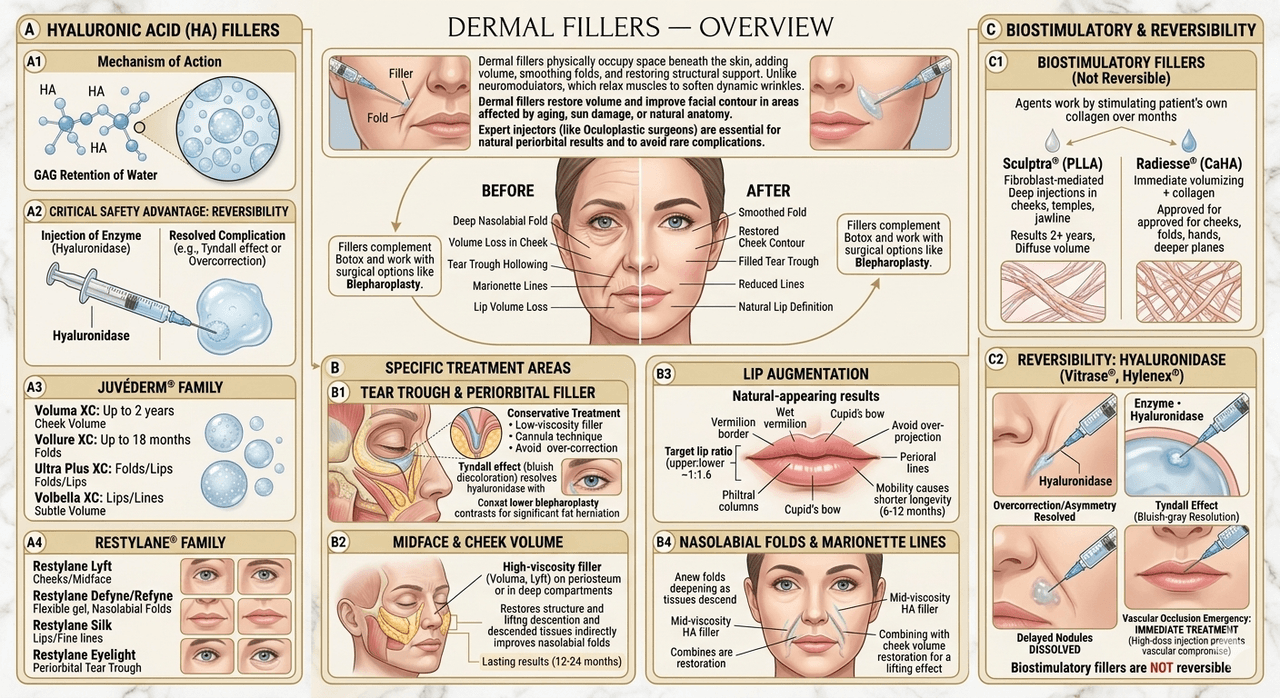
Hyaluronic acid (HA) is a naturally occurring glycosaminoglycan that retains water and gives skin its plumpness. HA fillers are cross-linked to increase longevity and come in varying particle sizes and viscosities for different depths and areas of treatment. The critical safety advantage of HA fillers is their reversibility — an enzyme called hyaluronidase that can break down HA filler (often requiring adequate dosing and sometimes more than one treatment).
Juvéderm® Family (Allergan/AbbVie)
Restylane® Family (Galderma)
The tear trough — the concave groove at the junction of the lower eyelid and cheek — is one of the most requested and technically demanding filler treatments. As the midface descends with age and orbital fat herniates forward, this groove deepens and creates a shadow that imparts a tired, hollow appearance even in well-rested patients.
Midface volume loss is one of the earliest signs of facial aging — the malar fat pad descends, deepening the nasolabial fold and creating a triangular "skeletonized" appearance. High-viscosity fillers (Voluma, Restylane Lyft) placed in the deep fat compartments or at the periosteum restore structural support, elevate descended soft tissues, and improve the nasolabial fold indirectly:
The nasolabial fold (the crease from nose to mouth corner) and marionette lines (from the mouth corner toward the chin) deepen as midface tissues descend. Mid-viscosity HA fillers can be placed directly within these folds or used in combination with cheek volume restoration for a lifting effect. True improvement often comes from treating the structural cause (midface descent) rather than the fold itself.
HA fillers define the vermilion border, increase lip volume, and reduce perioral lines. Precise injection into the lip body (wet vermilion), white roll (vermilion border), philtral columns, and Cupid's bow defines lip architecture. Natural-appearing results:
Unlike HA fillers, biostimulatory agents work by stimulating the patient's own collagen production over months. They are not reversible.
Hyaluronidase (Vitrase®, Hylenex®) is an enzyme that dissolves hyaluronic acid — making HA fillers uniquely reversible. It is used for:
Biostimulatory fillers (Sculptra, Radiesse) are not reversible and require greater precision at injection.
Connect with a board-certified oculoplastic surgeon who specializes in fillers.
Search the Directory →